
The Science of Shutdown: A Polyvagal Perspective
By Jessica Michels, LAMFT
Sometimes the scariest thing you can feel is like you feel nothing at all. So many of us have been there: numb, disconnected, lost in a sea of detachment without emotions or sensations to anchor us. It can be confusing and, honestly, pretty terrifying. Though the research suggests this disconnection may be one of our most primitive forms of self-protection.
You might be asking yourself, how could something that can feel so bad be intended for good? It helps me to think about it as a form of mental mercy, an emergency brake our nervous system may use as its last resort when pain feels overwhelming and unrelenting. Dr. Stephen Porges’s Polyvagal Theory offers one perspective on this irony quite thoughtfully:
Polyvagal Theory proposes that our nervous system reacts to safety and danger—even when we’re not conscious of it. It’s like a built-in surveillance system for threats and safety running on neuroception. Neuroception is our body’s automatic ability to detect safety, danger, or life threat without our conscious awareness. It acts as an internal radar that is constantly scanning our environment for cues. This is not always objective. Our histories and experiences can impact the stimuli we individually perceive as safe or dangerous.
Danger includes physical, emotional, and social threats. Of course, it could be being chased by a wild tiger. But it could also be being chased out of a friend group, a concerning email from a boss, a self-critical spiral, or a knowing glance from a scary parent.
There Are Three States of the Nervous System
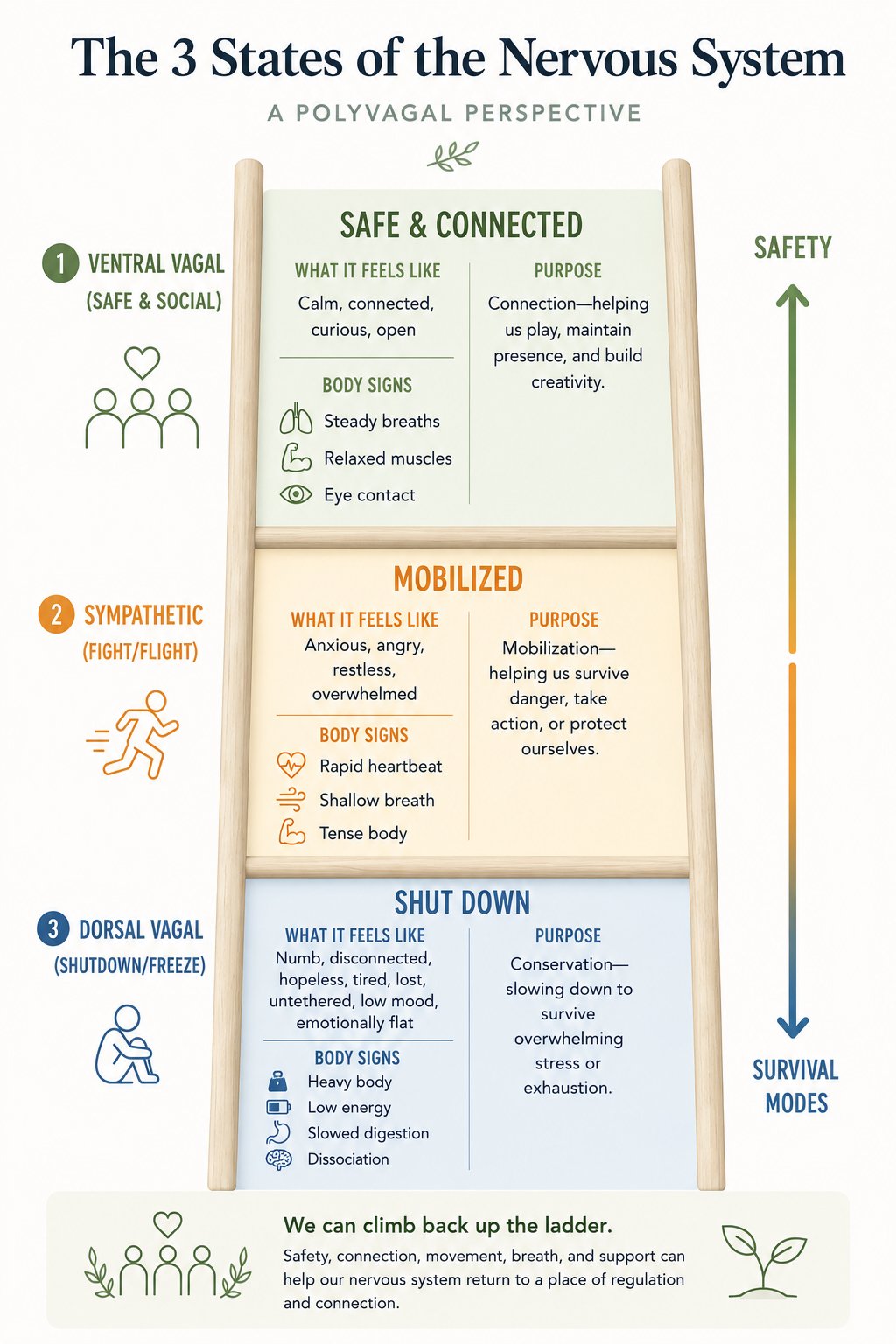
According to Polyvagal Theory, these states tend to be organized hierarchically. Our nervous system often responds in a step-by-step progression from states of safety toward survival responses and vice versa, much like climbing up or down the rungs of ladder. As a result, many people move from ventral vagal regulation through some degree of sympathetic activation before entering a dorsal vagal shutdown state. From this perspective, shutdown can be understood as one of the nervous system's last defenses against a stress or threat. When the nervous system can no longer sustain the energy required for fight-or-flight activation, anger, or anxiety, it may shift into shutdown. For many people, this includes some degree of dissociation. Dissociation is a disconnection from thoughts, feelings, sensations, or memories, and it exists on a spectrum. Regardless of its severity, its protective functionality is similar: conserving energy and shielding us from further physical, psychological, or emotional harm.
Now that we understand the why, you’re probably wondering how the heck do we get out of shutdown?
I have bad news and good news. The bad news is that when we’re deeply shut down, it’s often not enough to aim to think our way out of it. As a chronic intellectualizer, I have certainly tried to no avail. For my fellow intellectualizers, here is some science as to why. When we're in shutdown, our bodies shift into a low-energy state focused on conservation. Within this state, flexible thinking, planning, and problem-solving become much harder to access until our nervous system begins to feel safer. The good news is we can move to a place where our brains can be appropriately effective again. We just must first wake up our bodies through bottom-up interventions. Some helpful strategies include:
Mindfully engage your five senses
Try a few minutes of gentle movement or, if it feels accessible, more vigorous exercise
Dance around your room to upbeat music
Balance or challenge your coordination
Hold something cold
Describe 3 things you see in your space with vivid detail
Scan your body
Connect with a friend or loved one
This one might sound cliché, but it’s incredibly effective. Polyvagal Theory highlights our capacity for co-regulation. We are wired to connect—our nervous systems support one another’s regulation through relationships. So, though it may feel particularly hard to get up and reach out when we’re feeling shut down, it may be the most effective way to help our nervous system move back up into safety.
So, for anyone who has every felt shut down or may be experiencing it right now, the science is on your side. It suggests you are not broken nor doomed to a life of disconnection. Your nervous system is likely protecting you just as it was designed, and your body is your guide back into feeling. The path may be longer and less pleasant than our preference. But you are not lost. There is a place for you on the Polyvagal ladder, and I hope knowing where you are shows you some tools that can help you climb your way back up the rungs.

Jessica Michels, LAMFT is a licensed associate therapist in Philadelphia, Pennsylvania working out of our Ardmore location. Jessica works with a wide array of individuals and couples and feel particularly drawn to work with adult children of emotionally immature parents, survivors of narcissistic abuse, complex/relational traumas, self-esteem challenges, and life transitions, as well as couples looking to deepen intimacy and improve communication. To schedule an appointment click here.
ABOUT A BETTER LIFE THERAPY:
A Better Life Therapy was founded in 2013 with a passion for providing warm, compassionate services to individuals and families in Pennsylvania. Our team specializes in relationship health as well as individual mental health. Our team has expertise in areas like anxiety, grief, depression, pregnancy related issues, sexual issues, substance use and trauma.
We currently have in person offices in:
Bucks County, Pennsylvania
Philadelphia, Pennsylvania
The Main Line, Pennsylvania
The Jersey Shore
The Lehigh Valley, Pennsylvania
Virtual Locations
If you prefer to do therapy from the comfort of your home, workplace, or while out in a park,check out our virtual locations. Right now we are able to offer virtual therapy for people residing in:
Colorado
Delaware
Florida
New Jersey
New York
Pennsylvania
Utah
Email us info@abetterlifetherapy.com
Call 267-838-0066
Services:
Read about our individual services
Read about our couples therapy services